In November, the essence of Christmas pervades the air. My annual Christmas tradition involves indulging in mince pies and pigs in blankets while watching classic films. As an ardent admirer of Disney movies, a pilgrimage to Disney World remains a cherished item on my bucket list. Among the plethora of films, “The Lion King” stands as my all-time favourite. The scene where Rafiki discovers Simba’s survival never fails to evoke tears.
The assurance of a loved one’s existence in our midst brings immeasurable contentment and joy. Celebrating life itself is paramount. Originating from Pakistan, I have intimately witnessed violence and persecution. Open Door USA ranks Pakistan fifth globally in terms of religious persecution, particularly Christian persecution. Upholding faith in fragile terrains like Pakistan poses challenges, yet as Christians, we discover solace in our God—a Living God! Jeremiah 10 in the Bible emphasizes:
But the Lord is the true God; he is the living God, the eternal King.
– Jeremiah 10:10
During Jesus’ presence in Caesarea Philippi, he queried his disciples about his identity. Peter responded:
You are the Messiah, the Son of the living God.
– Matthew 16:16
While most religious founders passed away without resurrection, Christians stand firm in serving a living Saviour. Revelation 1:18 asserts that Jesus lives on, having triumphed over death—a truth unique to Christianity.
Don’t be afraid. I am the First and the Last, and the Living One. I was dead, but look—I am alive forever and ever.
– Revelation 1:17-18
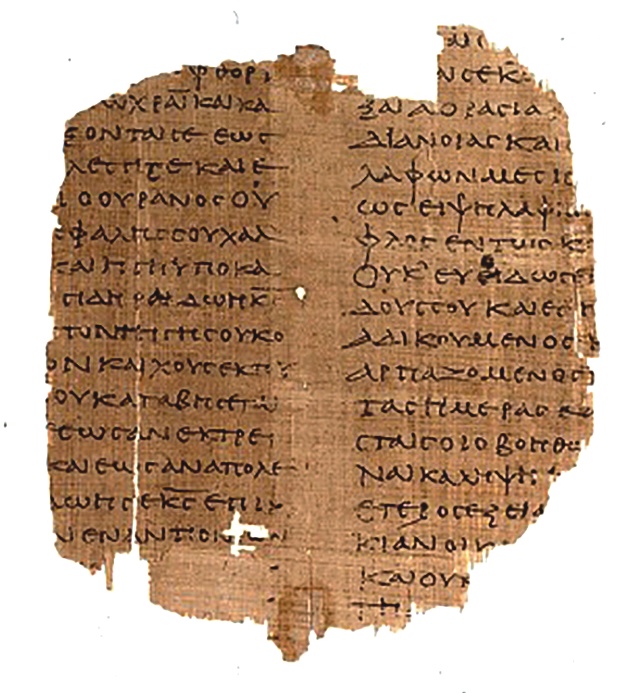
The term “biblos” in Greek signifies “sacred writing” or “scroll.” It appears in the New Testament across Mark, Matthew, Luke, and three other books. Hebrews 4:12 affirms the living and dynamic nature of God’s Word. This living Word within the Bible holds a distinctive power, effecting enduring, supernatural changes within individuals. My own life underwent a transformation upon delving into the Word, witnessing its vitality in action. The living God works through his Word, intertwined with the Holy Spirit, shaping lives and unveiling mysteries with each reading. According to the psalmist, the person who meditates on and delights in the Word will be “like a tree planted by streams of water, which yields its fruit in season and whose leaf does not wither”.
For the word of God is living and active, sharper than any two-edged sword, piercing to the division of soul and of spirit..
– Hebrews 4:12
I adhere to the belief of Biblical inerrancy supported by textual criticism. The doctrine of sola Scriptura, embraced by the Protestant Reformers, emphasizes the correction of errors propagated by other authorities, such as post-biblical church tradition, which are considered equal to Scripture as a rule of faith. The doctrine of biblical infallibility asserts that the Bible is incapable of teaching error. It affirms that the Word of God is fundamentally free from falsehood, which I refer to as Biblical inerrancy. John Calvin conveys this concept in one of his texts, stating, “The word of God is pure, and without any mixture of fraud and deceit, like silver which is well refined and purified from all its dross“.
It is imperative to note that when I refer to biblical inerrancy, I specifically address the original text of Scripture, not its manuscript copies. Fortunately, this poses no issue, as the Bible has been preserved better than any other ancient book. Consequently, we are able to reconstruct the original text as written by the Apostles and prophets. In John 17:17, the Word of God is referred to as the embodiment of truth. Timothy affirms that all scriptures are ‘God-breathed‘.
Sanctify them by the truth; your word is truth.
– John 17:17
All Scripture is God-breathed and is useful for teaching, rebuking, correcting and training in righteousness, so that the servant of God may be thoroughly equipped for every good work.
– 2 Timothy 3:16-17
Muslims claim that both the Old and New Testament have been changed, and that the Bible is no longer trustworthy. They conclude that it was necessary for Allah to give another book, Qur’an, in its place.
How can Muslims make such claims in the face of all the evidence to the contrary? To begin with, they will usually claim that the Qur’an itself states that the Bible has been corrupted. There are indeed a few passages which accuse the Jews of Medina in Muhammad’s day of “corrupting” their Scriptures, although Muslim commentators themselves are not agreed as to what is meant by this. Many earlier commentators held that all that is meant is that they misquoted, not altered, the text. In any case, one may safely say that these verses are not the real reason for the claim. Allah refers back to the old scripture to authenticate the Quran. In one verse of the Quran, it says:
“ He has revealed to you the Book with the truth, confirming the scriptures which preceded it; for He has already revealed the Tawrat and the Injil for the guidance of men, and the distinction between right and wrong.”
– Quran 3:3-4.
In another verse, it also advises people who doubt the Quran to consult the previous scriptures;
“ If you doubt what We have revealed to you, ask those that have read the Scriptures before you.”
– Quran 10:95.
Muslims have neither studied the manuscript evidence for the text of the Old and New Testaments, nor the principles of textual criticism. Manuscripts of the Old and New Testaments dating back to several hundred years before the rise of Islam are displayed in well-known museums across the world (including London). Anyone can compare the Bible we have today with these manuscripts and see that it has not been corrupted. These all confirm the integrity of the text Christians use to this day.
These ancient manuscripts provide a fascinating glimpse into the historical development and preservation of the Bible. Scholars have dedicated their lives to meticulously studying and analysing these biblical manuscripts, scrutinizing their authenticity and reliability. The methods of textual criticism employed by these scholars involve a careful examination of the available manuscripts, comparing variant readings, and establishing the most accurate text possible.
Moreover, the manuscript evidence for the Bible is not limited to just a few copies. There are thousands of biblical manuscripts spanning different time periods and regions, written in various languages such as Greek, Hebrew, and Aramaic. These manuscripts are not only found in museums but also in libraries and universities around the world. They form a vast body of evidence that supports the consistency and accuracy of the biblical text.
The fact that these manuscripts predate the rise of Islam is significant because it demonstrates that the text of the Bible existed well before the advent of the Islamic faith. It highlights the separate historical trajectories of these religious traditions and their respective sacred texts. While the Quran is the primary religious text for Muslims, it is important to acknowledge the existence of other religious texts, such as the Bible, and the significance they hold for different faith communities.
It is crucial to approach discussions about religious texts with respect and an open mind. Understanding the historical context, textual transmission, and the evidence of manuscript traditions can contribute to constructive interfaith dialogues. Rather than dismissing the knowledge and perspectives of others, it is beneficial to engage in informed discussions that foster mutual understanding and appreciation of diverse religious beliefs.
We pray to Father, to guide all souls from darkness to light in Jesus name. Amen !


 Moses Ali
Leave a comment